It Takes a Team: Mindfulness, the Nervous System, and Healing Together
written by Emily Horn
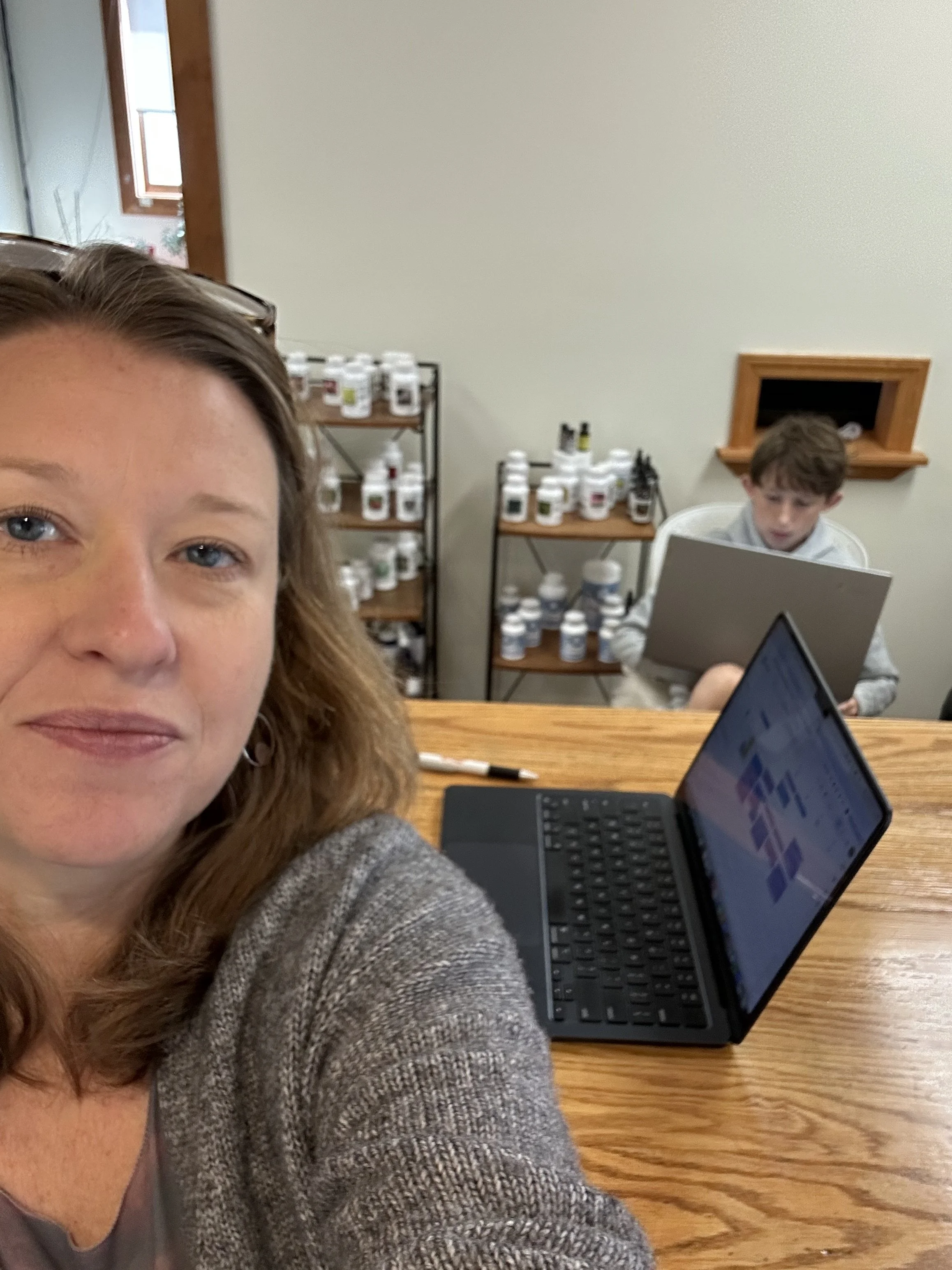
Emily Horn & Zander Horn @Mindful Wellness Space
One of my first memories of learning mindfulness meditation is sitting on the green near the Brickyard at North Carolina State University. I was still a closet meditator, and my boyfriend at the time — now my husband — introduced me to it on CDs. The set was called Insight Meditation, with a Buddha on the cover, by Sharon Salzberg, Jack Kornfield, and Joseph Goldstein. Little did I know that I would go on to become one of the leaders in the vast sea we now call mindfulness. There was so little available back then that my own teachers would say they'd started with a single dharma book. I was fortunate to have that Sounds True CD set — and later, thanks to Tami Simon, the founder of Sounds True, access to many more voices. (Fun fact: I was Tami's executive assistant for a year.)
Now there are so many voices that one of the questions I get most often is: What practice should I do? And what's the point?
There are so many voices now, and so many kinds of meditation — concentration, mantra, visualization, movement, loving-kindness, and on and on. It can be genuinely hard to navigate, a little like trying to choose the right retreat. Where do you even begin?
This one is grounded in mindfulness. I'll be honest about why: it's what I know most deeply. I found these practices in my early twenties, before the current wave of popularization, and for more than eight years now I've been training other teachers in how to teach mindfulness meditation. I love that it can be offered in a secular way — one that gives you integrable, systematic skills you can actually use, and that a growing body of science backs up. And it's humbling to remember these practices aren't new at all: people have been refining them for some 2,500 years.
That same depth of lineage runs through the rest of the morning. Acupuncture and Chinese medicine, Applied Kinesiology and functional medicine — each draws on traditions developed and tested over thousands of years. So what we're offering isn't a trend. It's three highly trained practitioners weaving together time-honored approaches for one morning of settling in, feeling comfortable, and easing the stress your nervous system has been carrying.
The one need I keep coming back to, through all of it, is nervous system regulation. We can frame it in scientific terms now, thanks in large part to Jon Kabat-Zinn, who popularized mindfulness meditation and built a secular framework showing that these practices — often rooted in religious or spiritual contexts — are beneficial to our whole human experience.
The research has caught up, too. Here are three things it now shows about training the mind:
It eases real symptoms. In a meta-analysis of 47 trials with more than 3,500 participants, mindfulness meditation programs produced moderate reductions in anxiety, depression, and pain (Goyal et al., JAMA Internal Medicine, 2014).
It calms the brain's alarm system. After eight weeks of mindful-attention training, participants showed reduced activity in the amygdala — the brain's fight-or-flight center — in response to emotional images, even when they weren't actively meditating. That points to a lasting shift in how the nervous system meets stress (Desbordes et al., Frontiers in Human Neuroscience, 2012).
It reaches the body, not just the mind. An eight-week mindfulness program shifted brain activity toward a pattern associated with positive emotion and strengthened participants' antibody response to a flu vaccine — early evidence that what we practice in the mind shows up in the body (Davidson, Kabat-Zinn, et al., Psychosomatic Medicine, 2003).
It isn’t a magic cure. But it tells us something hopeful: the nervous system is trainable, and the calm we're after is a skill, not a stroke of luck.
However, I used to think mindfulness would be the complete cure. How many times have you thought you'd found one?
I was reminded again there is no single cure when I was hospitalized in my mid-thirties with what would be diagnosed as an autoimmune disorder affecting my nervous system. That's when I deeply remembered: I had never only practiced meditation. Throughout my life, I'd been weaving together many modalities to support my health and wellbeing.
This is what we're experimenting with at Mindful Wellness Space: weaving those modalities together into one holistic approach to nervous system regulation. I've learned it takes a team. Maybe you have, too. So we'd love for you to join us for a holistic mini retreat.
These mornings are therapeutic, and they can open the door to a more diagnostic approach down the road. But the retreat itself is aimed at nervous system regulation and learning skills you can carry with you. There will be acupuncture and Chinese medicine, Applied Kinesiology and functional medicine, and I'll lead us in a mindfulness practice — settling in with the intention to be present and attuned to a deepening sense of wellbeing.
To learn more, visit our retreats page.
Our next mini retreat is Saturday, September 12, 9 a.m.–noon, in Black Mountain, NC. Reserve your spot →
Sources
Goyal M, et al. "Meditation Programs for Psychological Stress and Well-being: A Systematic Review and Meta-analysis." JAMA Internal Medicine, 2014.https://jamanetwork.com/journals/jamainternalmedicine/fullarticle/1809754
Desbordes G, et al. "Effects of mindful-attention and compassion meditation training on amygdala response to emotional stimuli in an ordinary, non-meditative state." Frontiers in Human Neuroscience, 2012.https://www.frontiersin.org/articles/10.3389/fnhum.2012.00292/full
Davidson RJ, Kabat-Zinn J, et al. "Alterations in Brain and Immune Function Produced by Mindfulness Meditation." Psychosomatic Medicine, 2003.https://pubmed.ncbi.nlm.nih.gov/12883106/